Parents of children with autism often notice something powerful: curiosity can be intense, specific, and beautifully persistent, until life gets too loud, too fast, or too demand-heavy. The goal isn’t to “make your child curious.” It’s to protect the curiosity that’s already there and shape home life so exploration feels safe, rewarding, and doable. When curiosity is supported, it can grow into engagement, independence, and a steady sense of “I can figure things out.”
Support starts with trust: your child needs to feel seen, not managed. Then comes structure: predictable routines and clear choices reduce stress so curiosity has room to show up. Finally, you build momentum: tiny wins, repeated often, turn interests into skills without turning learning into a tug-of-war.
Some days curiosity is a monologue about elevators. Other days it’s silent, just staring at how sunlight hits the carpet. Both can be learnings.
⦁ Offer two choices: “Do you want to read about whales or watch a short whale video?”
⦁ Create an “I wonder…” jar with simple prompts (draw one when the mood is right).
⦁ Set up open-ended materials: blocks, paper, tape, magnets, old maps, a box of safe objects.
⦁ Ask observational questions (“What do you notice?”) instead of quiz questions (“What is it?”).
⦁ Use special interests as bridges: a dinosaur phase can lead to measuring, drawing, categorizing, storytelling.
If a question feels like pressure, it stops being curiosity and becomes a performance.
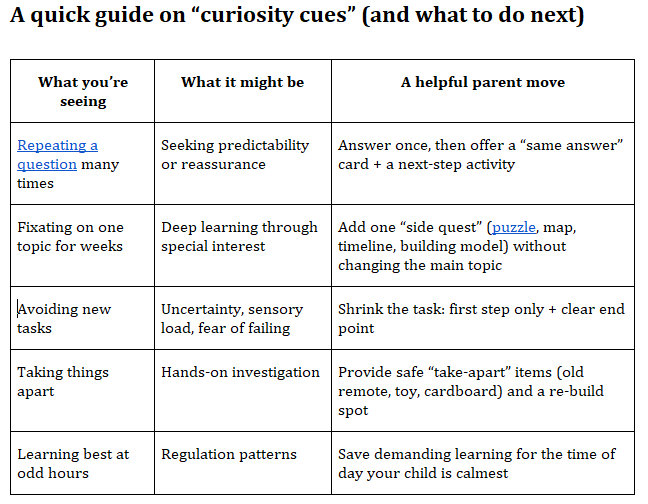
Many parents want to support learning but feel stretched thin, and the guilt can get heavy. A small plan can lower the pressure: decide in advance where learning “lives” in your day, even if it’s only 10 minutes. That’s why making time to help your kids learn can be less about finding extra hours and more about choosing consistent moments, like dinner prep, bath time, or a quick walk, to talk, notice, and wonder together. If your schedule is packed, bedtime can be a surprisingly strong window for connection: a few pages, a shared story, or even re-reading the same favorite book can build comfort and a love of language over time.
Try this as a reset when things feel stuck or “everything is a battle.”
⦁ Day 1: Pick the interest. Write it down (one interest only).
⦁ Day 2: Choose one container. A bin, folder, or shelf that holds materials related to that interest.
⦁ Day 3: Set the smallest routine. Same time, same place, 5–15 minutes.
⦁ Day 4: Create a “start” signal. A visual card, timer, or short phrase you always use.
⦁ Day 5: Add one stretch. One new step: sorting, measuring, drawing, labeling, or explaining.
⦁ Day 6: Celebrate effort, not correctness. Name what you saw: “You kept going.”
⦁ Day 7: Let your child teach. Have them show a sibling, stuffed animal, or you, teaching builds confidence fast.
If a day goes sideways, you don’t “fail.” You gather data and shrink the steps.
Make it not-school. Follow the interest, keep it short, and remove the “right answer” vibe. Curiosity thrives when it feels optional.
That’s still learning. Use the interest as a gateway: reading, math, writing, social stories, maps, timelines, simple experiments, all can attach to one topic.
Build a predictable “start” routine and then step back. Your job is to set the stage, not direct every move.
Pause and reduce demand, yes, but don’t abandon curiosity. Keep the same interest and introduce novelty in micro-doses (one change at a time).
If you want a grounded, autism-informed guide created with autistic voices, this guide from the Autistic Self Advocacy Network is a strong place to begin. It’s designed to help families understand autism without framing it as something to “fix,” and it points toward supportive next steps. Many parents find it helpful because it centers respect, communication, and practical advocacy.
Curiosity doesn’t need a fancy curriculum, it needs safety, time, and a parent who notices what lights their child up. Keep learning small, predictable, and connected to real interests. Use routines to reduce stress, and use tiny “stretches” to build growth without power struggles. Over time, those small moments add up to a child who trusts their own mind and wants to keep exploring.

https://parentingwithkris.com/
.avif)